


Bridge Wallet is a self-custodial app that helps users move between bank accounts and self-custodial crypto as easily as possible. They can buy crypto, swap assets, and cash out to a bank account in a few taps , among other features. With Zyfai, Mt Pelerin has now added a new option for users holding USDC, ETH, or EURC: access to automated onchain yield.

 DeFi yield without headache, now in our mobile app Bridge Wallet!
Enjoy 1-tap deposits into self-custodial vaults that auto-compound and auto-rebalance funds when better yields or alerts are found, powered by @Zyfai_
 Discover: mtpelerin.com/bridge-wallet

Users access yield from their asset screen, choose a strategy, and manage their yield allocation through the wallet. Our infrastructure handles the DeFi execution and monitoring behind it.
A wallet built around everyday access to crypto
Bridge Wallet is a self-custodial mobile wallet developed by Mt Pelerin, a Swiss crypto broker established since 2018. It is available on iOS and Android and combines crypto wallet features with Mt Pelerin's buy, swap, and cash-out services.
Mt Pelerin's crypto exchange service has more than 200,000 users and over $1 billion in transferred volume. Bridge Wallet itself has 200,000+ downloads on app stores.
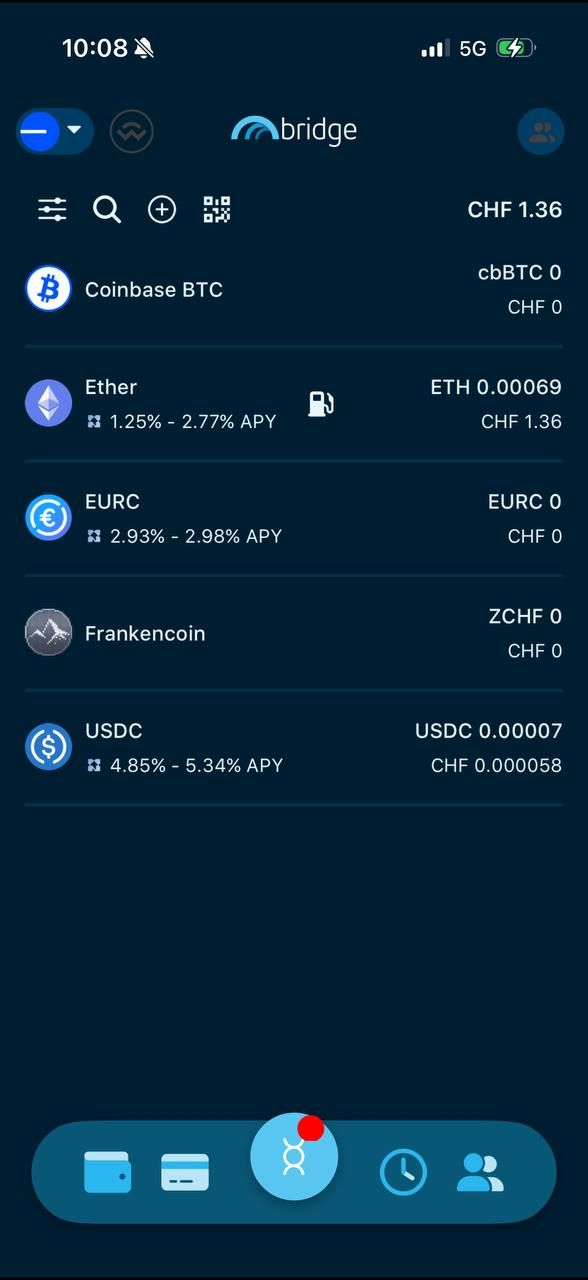
Its personal crypto IBAN feature connects those services to bank transfers. Users can receive fiat converted into crypto in their own wallet, or send a bank transfer using crypto.
The Zyfai integration adds a way to manage yield on USDC, ETH, and EURC within that existing product. A user holding any of these assets can allocate part of the balance to a yield strategy without opening a separate DeFi interface or taking on the ongoing work of monitoring pools and moving funds as conditions change.
From the wallet balance to a yield strategy
Users can now earn yield on each supported asset and manage their positions directly within Bridge Wallet.
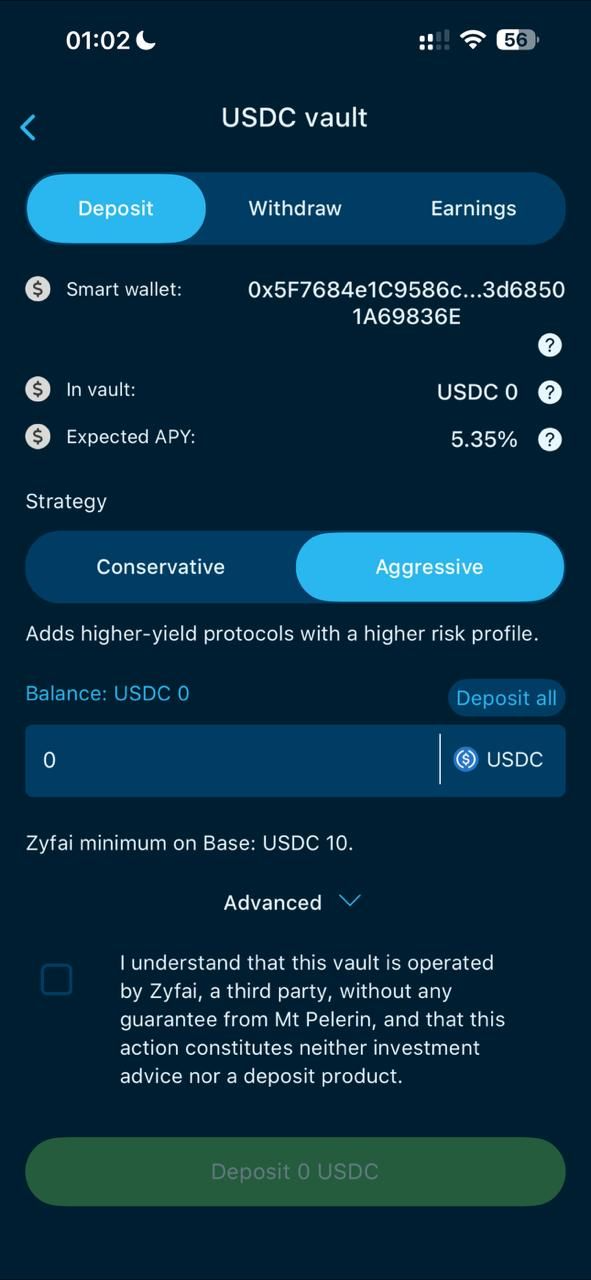
The deposit screen brings the main choices together:
Select Conservative or Balanced. The Balanced option adds higher-yielding protocols with a higher risk profile.
Review the expected APY, the deposited amount, and the asset balance available to deposit.
Enter a deposit amount and review the acknowledgement before proceeding.
The Earnings tab provides a separate view of net earnings, a breakdown by network, and the user's 30-day APY. Keeping expected APY and past earnings visible helps users distinguish the rate they are considering from what their allocation has earned.
Automated management through a personal Yield Agent
After the user chooses a strategy and deposits, their own rule-based Yield Agent manages the allocation within that strategy's rules. Execution is fully deterministic: predefined rules you set govern which actions the Yield Agent can take. Users can follow the position through Bridge Wallet while Zyfai handles the recurring monitoring and execution.
Our risk framework combines quant review with 24/7 automated monitoring.
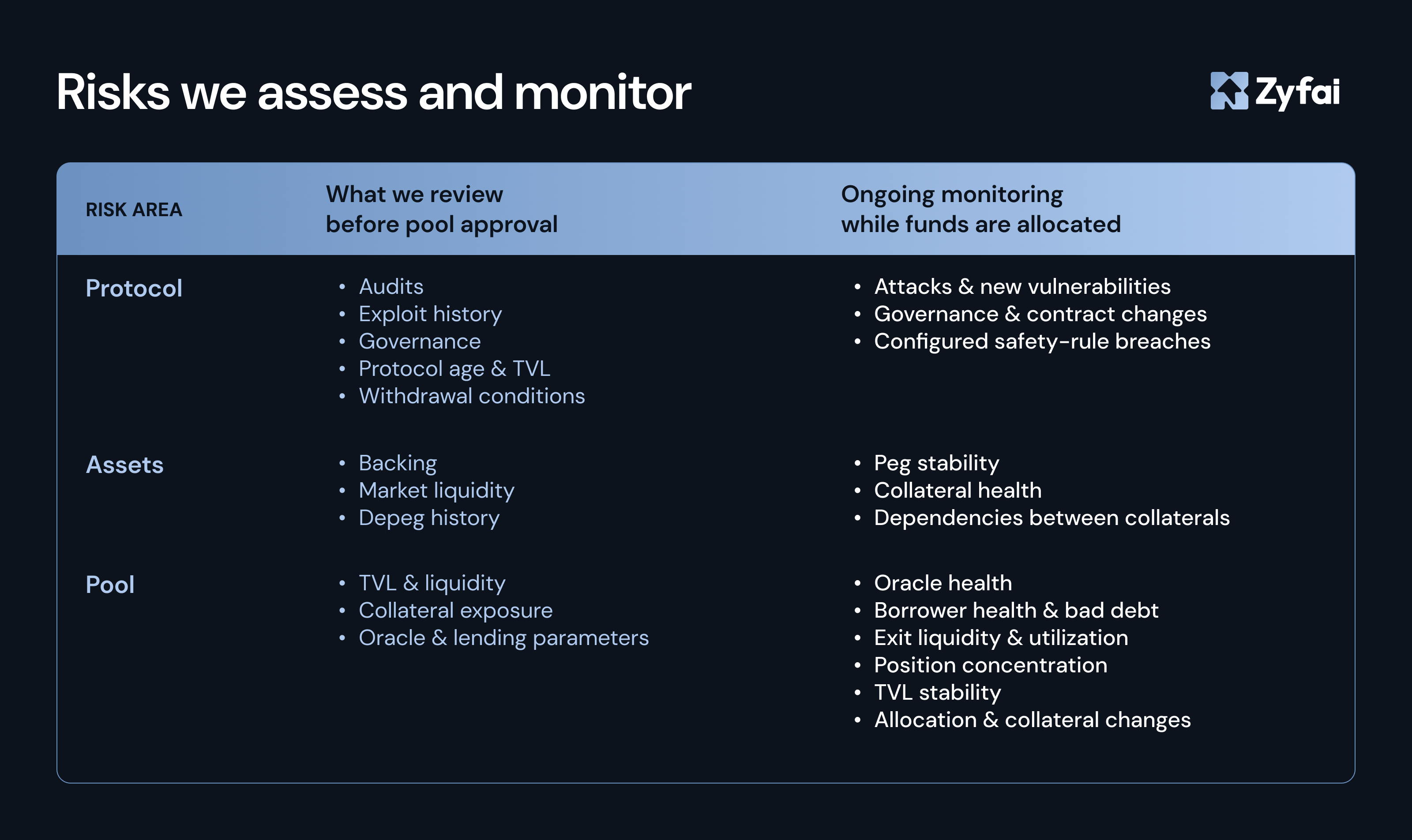
Before a pool becomes available, our quants review the protocol's security audits, unresolved findings, exploit history, governance controls, track record, and TVL. They assess the assets used as collateral, including their backing, market cap, trading volume, liquidity, and depeg history. At the pool level, they check TVL, available liquidity, and exposure to those assets against the strategy's requirements. For lending markets, they also review the price oracle and the loan-to-value limit at which borrowers can be liquidated.
Once a pool is approved, our monitoring layer tracks depegs, collateral health, liquidity, TVL stability, and changes in pool allocations around the clock. Real-time alerts also cover attacks on connected contracts, newly disclosed vulnerabilities, and breaches of configured safety rules.
Rebalancing serves two purposes: improving risk-adjusted yield and responding to deteriorating risk. Before a yield-seeking move, the Yield Agent checks whether the expected additional earnings justify the execution costs and whether the destination pool passes the relevant liquidity and risk checks. A higher displayed APY alone is insufficient.
If an asset backing a pool moves away from its target price, or too little liquidity remains for withdrawals, the Yield Agent can move capital away from the affected pool. These controls help manage exposure, while variable returns and underlying DeFi risks remain.

The SDK's Smart Account model
Zyfai's yield engine is built around user-owned Smart Accounts. Our SDK gives wallets, neobanks, and other integrators access to that engine. In this model, the user owns a Safe7579 Smart Account that holds their DeFi positions. If no safer pool passes the risk checks, funds can remain unallocated in that account.
As an integrator, you get access to 80+ DeFi pools through a single integration. No need to monitor them yourself or hire DeFi specialists.
Within that model, Session Keys give the Yield Agent permission to carry out approved strategy actions without requesting a signature for each rebalance. Our Security Proxy Gateway checks the target contract, function, and transaction parameters against the approved registry. It rejects transactions outside those permissions, including transfers to arbitrary addresses.
Adding yield without building a separate DeFi operation
A fintech team adding yield can take several routes, each with its own operating requirements:
Integrate a single curated vault and rely on that curator's allocation decisions and risk management.
Integrate several vaults, with a team to maintain those connections, while leaving users to compare vaults, choose where to deposit, and manage their positions.
Build a full in-house operation, hiring investment specialists and engineers to research protocols and pools, develop an execution engine, and maintain monitoring and rebalancing systems.
Mt Pelerin chose a fourth route: integrating the Zyfai SDK. The integration took a couple of days and gave the team access to a yield engine we have spent a year and a half developing. It covers Smart Accounts, deposits and withdrawal requests, strategy settings, and the position and earnings data needed for in-app reporting. Mt Pelerin can shape how users access yield in Bridge Wallet while relying on our infrastructure for its management.

The integration also gives Bridge Wallet an extra use case for USDC, ETH, and EURC balances between purchases, transfers, or cash-outs. Users can keep managing their yield allocation through the app they use for those activities. That gives Mt Pelerin another reason for users to return to Bridge Wallet, without requiring the team to build and maintain its own yield engine.
Explore Bridge Wallet on Mt Pelerin's website and follow Mt Pelerin on X.
About Zyfai
Zyfai gives you self-custodial access to autonomous low-risk DeFi. Our customizable rule-based Agents transform your idle capital into productive assets, rebalancing between curated opportunities.
The result is sustainable and risk-adjusted yield, where your capital is always working and under your control.