

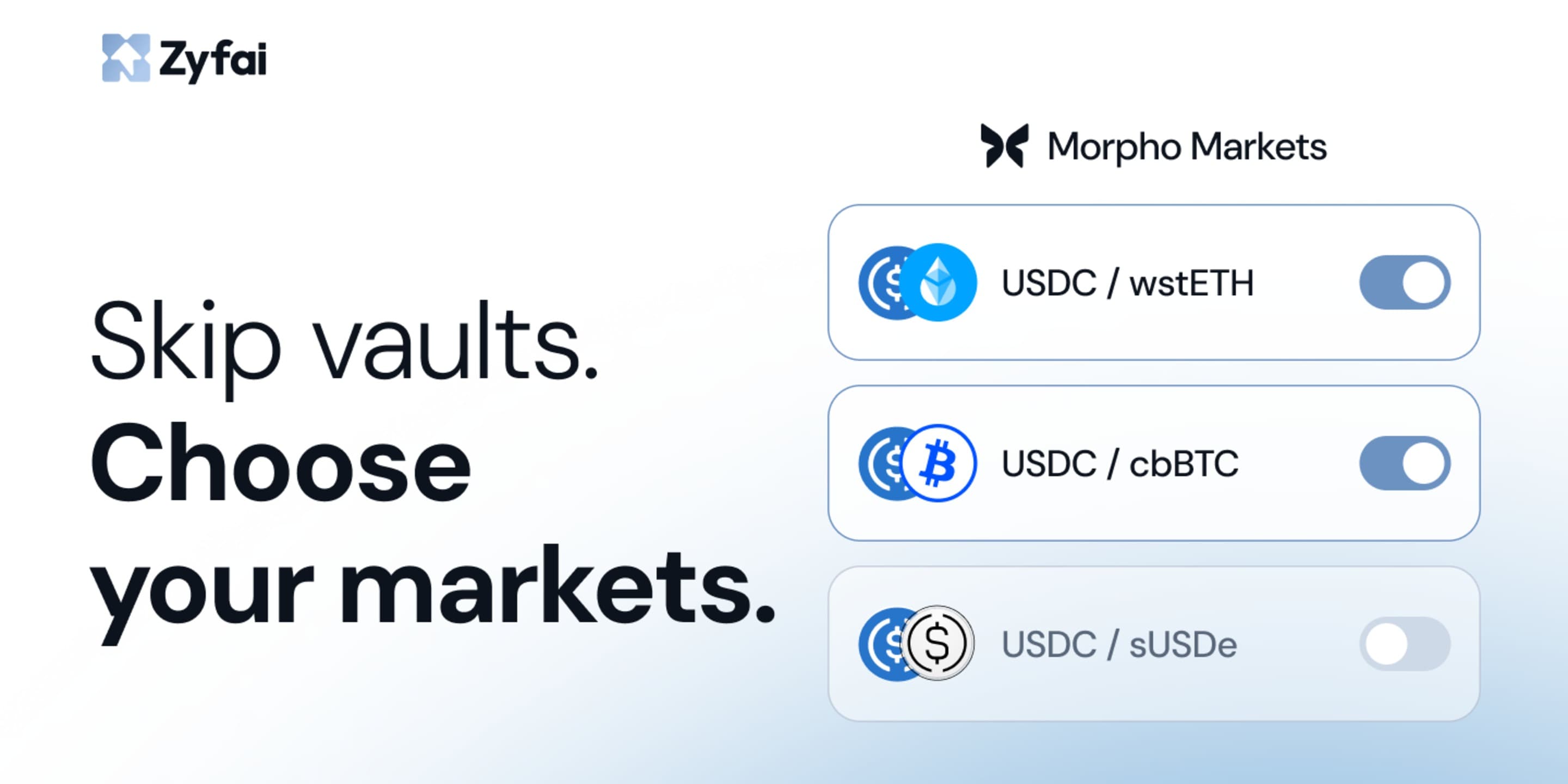
Two people depositing USDC can have very different views on risk. One may be comfortable lending against BTC and ETH but want no exposure to synthetic dollars. Another may accept a broader collateral set in pursuit of higher returns.
In a shared vault, both depositors participate in the same underlying portfolio, and neither of them chooses every market the vault lends to or every change to its allocation.
Vaults made automated allocation accessible. At Zyfai, we have executed more than $4.5B in cumulative rebalancing volume across different vaults, and more than 3,000 active users trust us to manage their allocations.
That experience has brought us to a question: how much more personal could automated yield become if the Yield Agent managed the lending positions directly?
Today, we are introducing direct support for Morpho Blue markets.
With this release, your personal, self-custodial Yield Account can hold lending positions directly in Morpho Blue markets, bypassing curated vaults. You choose the supported markets you are comfortable with, and your Yield Agent manages allocations within your chosen strategy and execution permissions.
Sherlock has audited this release end-to-end, with no high-risk findings. We have fixed and acknowledged all issues identified during the audit.
You can read the full audit report here: https://www.zyf.ai/sherlock-audit-october-2026.pdf
The goal is to bring automated lending closer to your own risk preferences. You keep automated allocation while removing the intermediary vault's allocation decisions, fee layer and share token from that lending path.
From vault shares to positions you own
When your Yield Account deposits into a Morpho vault, it receives vault shares. The vault holds the underlying lending positions, and its curator and allocators determine how capital moves within the vault's permitted strategy. Your exposure follows that shared portfolio. In practice, you hand your capital to a curator and trust them to keep risk in check, avoid costly mistakes and still find a good yield. And you pay a fee for that trust.

A Morpho Blue market, on the other hand, connects lenders supplying one asset with borrowers who pledge one specific collateral. In a USDC market backed by cbBTC, you supply USDC, borrowers post cbBTC, and you earn interest in USDC paid by borrowers.
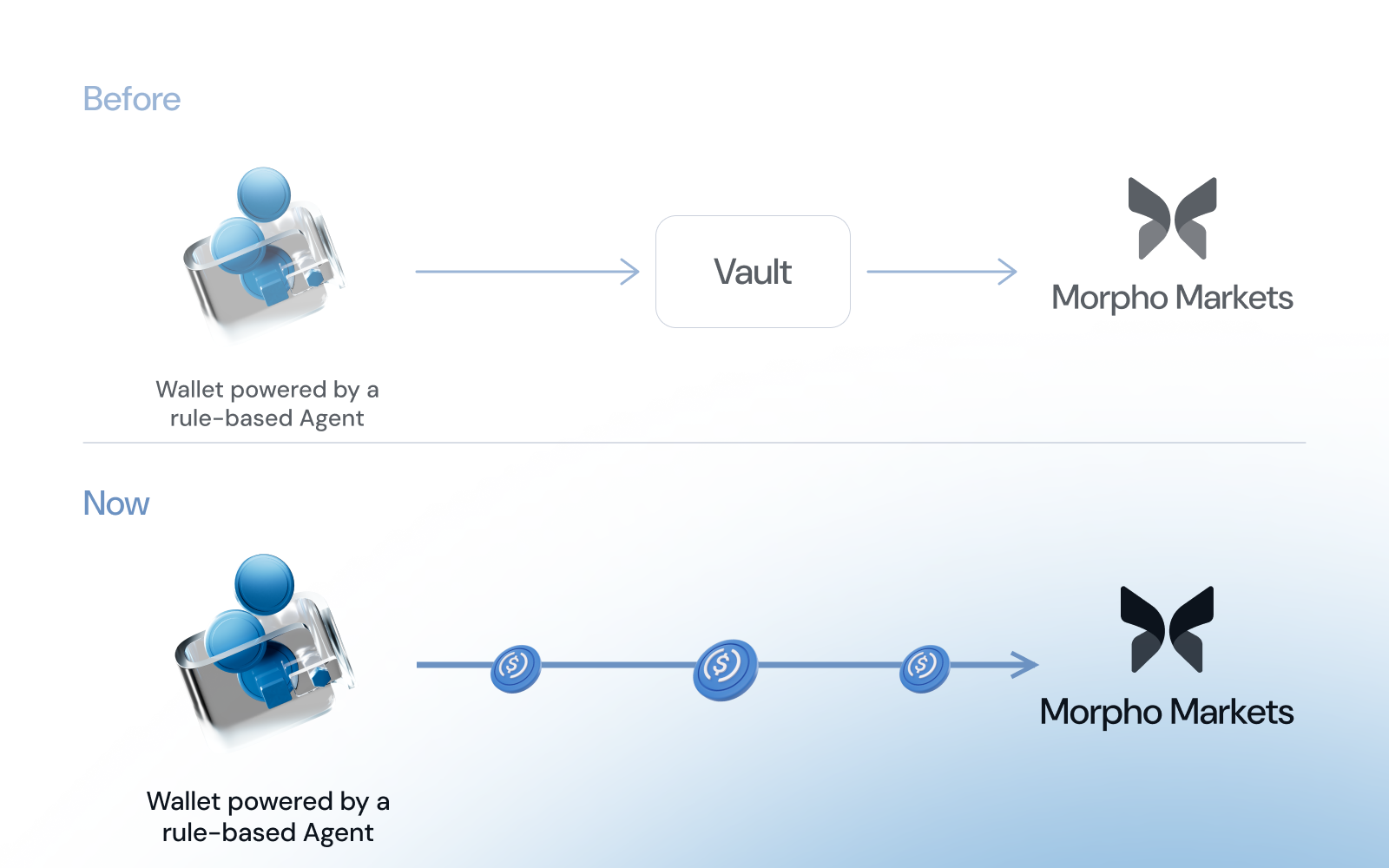
With direct market lending, your Yield Account holds the Morpho lending position itself. There is no intervening managed vault deciding where that position should be allocated. Your personal rule-based Yield Agent supplies your deposited assets to a chosen market, where borrowers pay interest to borrow against collateral, so Morpho records the lending balance under your self-custodial Yield Account rather than issuing it shares in a curator-managed vault.
Through a vault: you own shares in a vault, and the vault’s curator decides which markets your capital goes to.
Directly: you own positions in the markets you select, building a portfolio tailored to your risk preferences.

Your supplied assets join the liquidity provided by other lenders within the same isolated Morpho market. What disappears is the intermediate pooled vault. You can build a different set of exposures from another Zyfai user, even when you both lend the same asset.
Immutable markets make your exposure explicit
Morpho Blue, the variable-rate protocol behind these markets, fixes five market-defining parameters at creation:
Loan asset: the token you lend and borrowers repay.
Collateral asset: the token borrowers must pledge.
Oracle address: the contract used to value that collateral against the loan asset.
Interest rate model address: the contract that determines how borrowing rates evolve.
Liquidation loan-to-value, or LLTV: the debt-to-collateral threshold above which a borrowing position can be liquidated.
Those values cannot be replaced inside an existing market. A different collateral token, oracle address or LLTV means a different market. No curator can swap the collateral or change the LLTV of a market in your portfolio. That makes the configuration you select more predictable.
The market's fixed collateral also gives your Yield Agent a clear exposure to monitor and manage on your behalf. A market selected for one collateral asset cannot later accept a different one through a curator's allocation decision. If you want a different exposure, your account must take a position in another market.
You can choose among supported markets with different collateral, liquidation thresholds and oracle designs. The parameters of each existing market remain fixed.
All of these parameters, such as oracles (market price, exchange rate…) and interest rate models, will be available on the risk dashboard to give a clearer view of each underlying market.
Immutability covers a market's configuration. The interest rate model keeps adjusting rates as utilization changes, and collateral prices, oracle feeds and available liquidity keep moving.
That is exactly the part your Zyfai Yield Agent watches for you.
Fewer dependencies between you and the market
Bypassing a managed vault removes that vault's allocation decisions, governance configuration and any fees it charges from your lending position. You do not have to accept an entire vault portfolio to access one lending market inside it.
That matters when a vault reallocates toward collateral you would rather avoid. Morpho vaults have roles, caps and timelocks that constrain their operators, and their contracts can also be immutable. But even with those protections, depositors share the vault's allocation policy.
Direct positions let your own portfolio choices determine which markets you enter.
The fee benefit is equally specific. You skip the intermediary vault's fees wherever they are charged, which leaves more of the underlying yield in your position.
Direct supply also removes the vault's share token and its share-conversion logic. In the Vaults V1 donation-based inflation scenario documented by Morpho, an attacker can inflate a vault's share price by donating to its position in a market with an overstated collateral price. The attacker then borrows the donation back against that collateral and redeems the inflated vault shares using liquidity from the vault's other markets.
Holding lending positions directly removes this vault-level connection between markets.
For a conservative lending strategy, you can combine direct positions in vetted markets with Zyfai's continuous risk monitoring and rebalancing toward better yields. The result is account-level automation without handing a vault curator discretion over your portfolio.
Your market choices, managed continuously
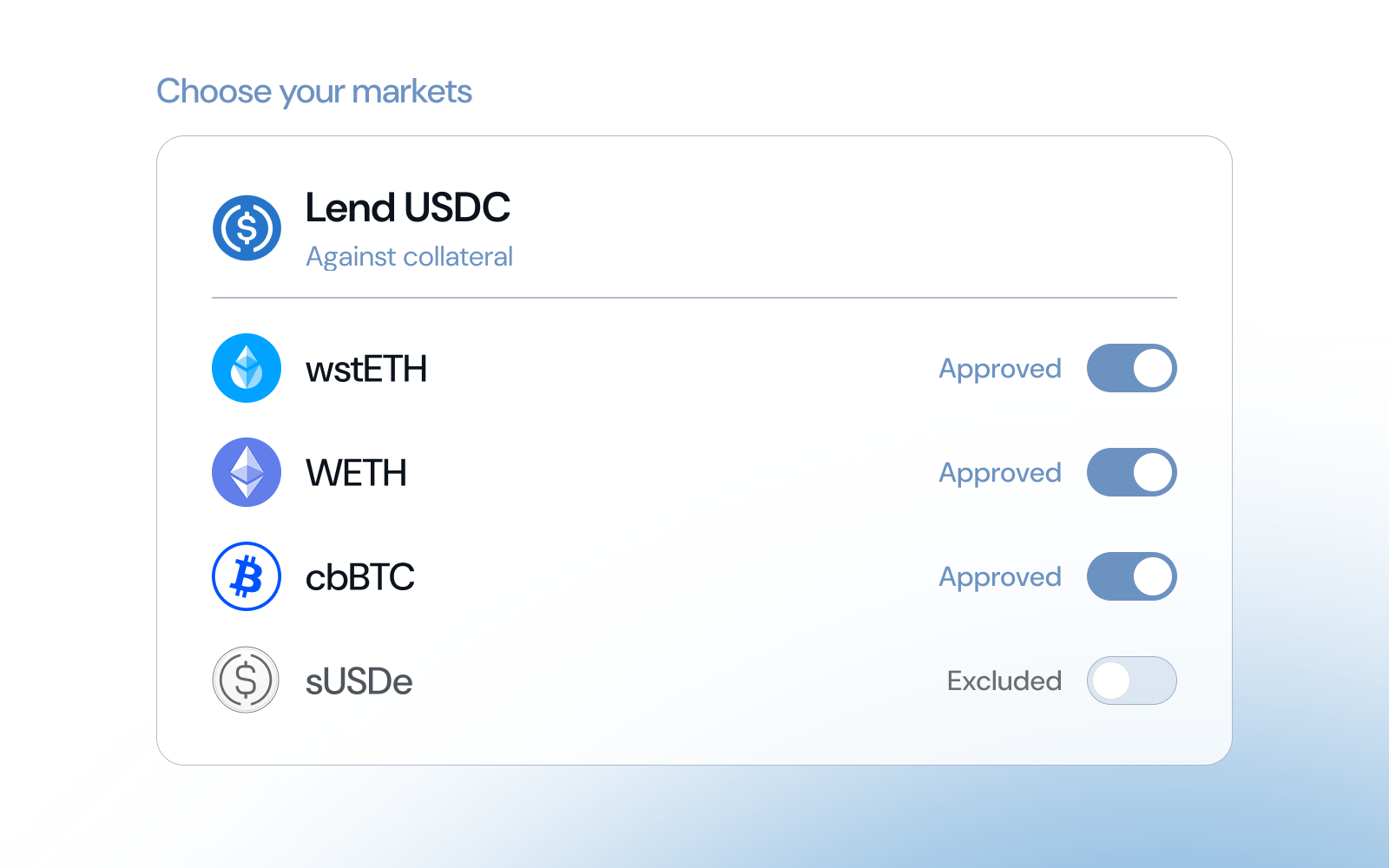
With this release, you can choose individual Morpho markets on the Customization page:
Open Customization in the Zyfai app.
Review the available Morpho markets and their collateral, APY and risk checks. Select the markets you want your Yield Agent to use.
Review and save your selection.
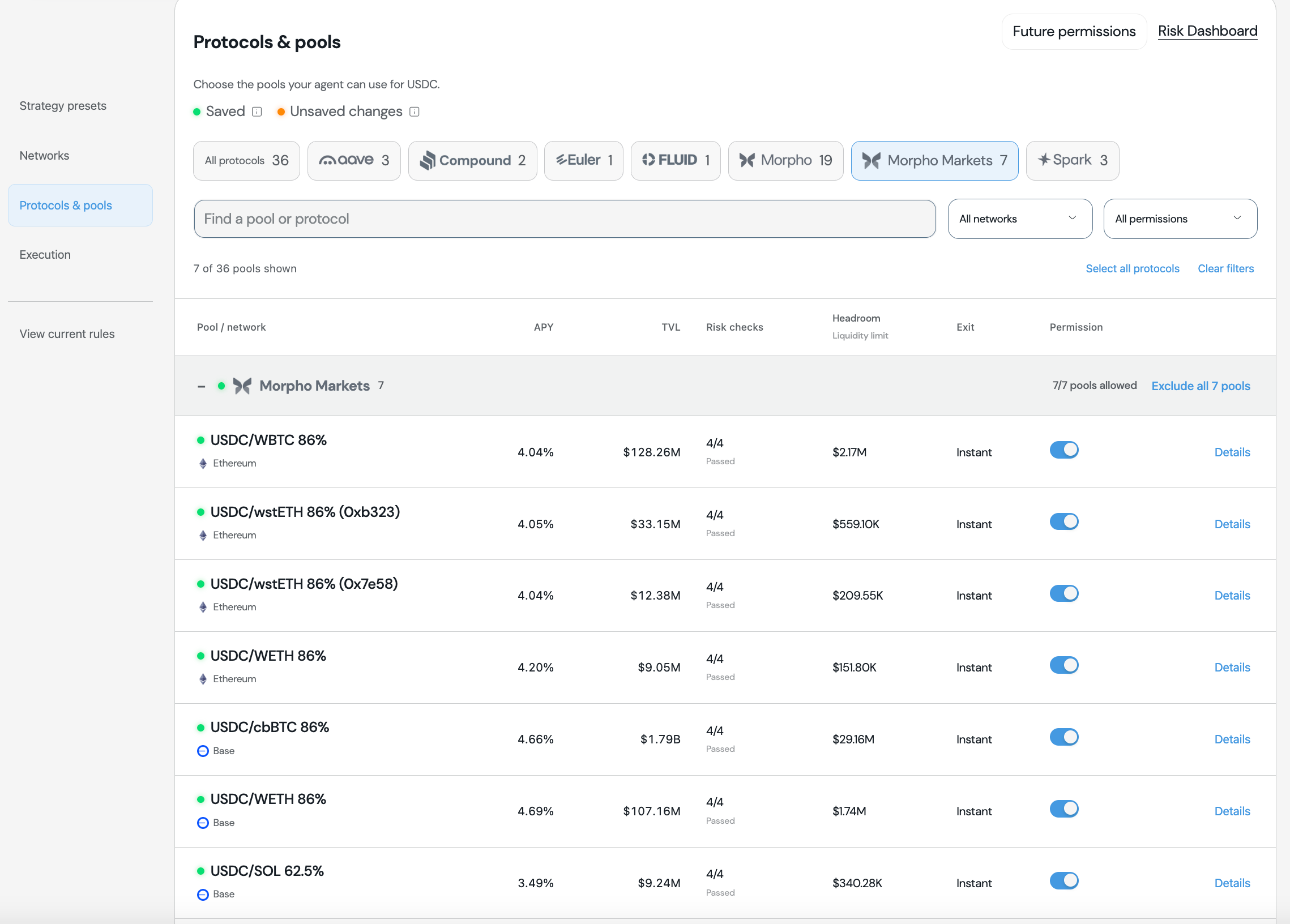
Your Yield Agent then allocates directly across your selected Morpho markets from your self-custodial Yield Account. These markets plug into Zyfai's existing allocation engine, where every yield opportunity is evaluated alongside risk and liquidity. Our risk framework checks each market before allocation and keeps watching it afterwards:
Oracle prices compared with the collateral's market price, and stale feeds.
The share of the market's debt held by borrowers close to liquidation.
Utilization, available withdrawal liquidity, and how large user and Zyfai positions are relative to the market.
Bad debt and any drop in the market's supply share value.
Collateral health, backing and depegs.
TVL drawdowns and unusual APY movements.
Real-time exploit alerts, including drops in a Morpho market's supply exchange rate.
Market sentiment and incident reports on X, alongside the onchain checks.
Some signals stop new deposits into a market while your existing position stays in place. Stronger signals move your funds out:
Deposits stop: an oracle gap above 1% or a stale feed, more than 20% of the market's debt near liquidation, or utilization above 92%.
Exit: an oracle gap above 2%, more than 40% of the market's debt near liquidation, or any bad debt or drop in the market's supply share value.
A higher displayed APY alone is never enough to enter a market. Your Yield Agent combines these signals with your market selection and Zyfai's existing checks on capacity, yield improvement and execution costs.
For example, suppose you want to lend USDC only against BTC collateral:
You select the supported BTC-backed markets, such as USDC/cbBTC, and leave ETH and other collateral out.
Your Yield Agent compares the markets you approved and manages rebalancing, so you do not have to watch rates and borrower health throughout the day.
Another user also selects WETH-backed markets. Their portfolio follows their selection, and yours stays unchanged.
Zyfai combines yield research and continuous risk monitoring with strict onchain execution guardrails. You can review our risk framework, emergency response rules, and rebalancing rules. The entire protocol has been audited end to end by Sherlock, with the new direct Morpho market support undergoing a separate audit before release.
Smart Rebalancing moves capital when the expected yield improvement justifies execution costs and liquidity checks pass. In an emergency exit, funds go straight back to your Yield Account. Our latest measured response took 7 seconds from alert to withdrawal. If no suitable alternative passes the checks, withdrawn assets stay idle in your Yield Account.
Your Yield Account is a Safe7579 Smart Account with you as its sole owner. You give your Yield Agent temporary, scoped permissions through Session Keys, allowing it to manage positions without asking you to sign every rebalance.
Our Security Proxy Gateway checks approved contracts, functions and transaction parameters onchain before each automated action. Even if a Session Key is compromised, transactions signed with it must still pass these onchain checks. Calls outside the permitted contracts, functions or parameter limits are rejected.
The Target Registry is an onchain contract listing the approved contract addresses and functions the Yield Agent can use. Your Session Key is scoped to that registry, so protocols and pools can be added or removed without requiring you to re-sign your Session Key each time.
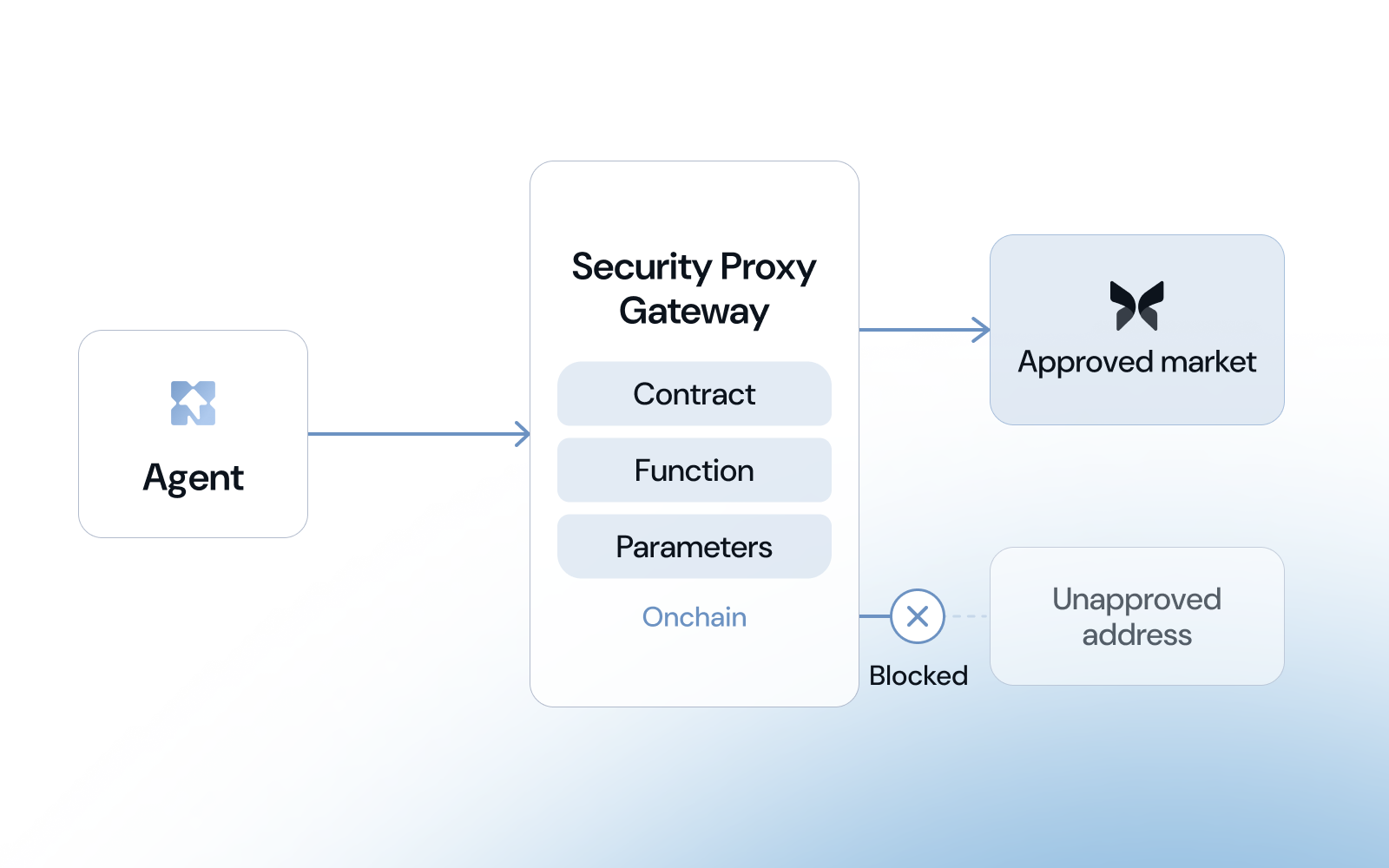
Every delegated transaction passes through the Gateway's Proxy Executor Module that checks the request against the registry before execution:
Contract address: the destination must be an approved target.
Function selector: the requested action must be approved for that contract.
Calldata parameters: the transaction's inputs must meet the configured rules. For example, a USDC transfer can go only to the user's own Safe Smart Account or an explicitly approved DeFi pool.
If a check fails, the executor rejects the transaction. These rules prevent the Yield Agent from sending funds to an arbitrary address or calling an unapproved function.
Execution follows deterministic rules. Your mandate, permissions and transaction limits define what your Yield Agent can do, and every delegated call must pass the onchain checks. An LLM cannot override those permissions or give itself authority to move your funds.
A foundation for borrowing, looping and refinancing
Direct lending is our next step toward personal onchain wealth management. It also provides the foundation for future strategies your Yield Agent could manage:
Borrowing: manage collateral, monitor loan-to-value and reduce debt within borrowing limits you approve.
Refinancing: move a loan to another approved market when better terms justify the costs and liquidity allows.
Looping: borrow to acquire more collateral, with automated debt monitoring and unwinding within a loan-to-value limit you approve.
Carry strategies: manage a yield-bearing position and its financing together, adjusting as borrowing costs and returns change.
Variable and fixed-rate rebalancing: lock in a fixed rate in markets such as Morpho Midnight when it pays more than variable-rate markets, and move capital back to variable rates when fixed-rate offers fall behind the term ends.
All of these strategies start from your own self-custodial Yield Account. Each strategy can be built around your own positions, markets you approve and borrowing limits you set, with a Yield Agent responsible for managing its full lifecycle.
About Zyfai
Zyfai gives you self-custodial access to autonomous low-risk DeFi. Our customizable rule-based Agents transform your idle capital into productive assets, rebalancing between curated opportunities.
The result is sustainable and risk-adjusted yield, where your capital is always working and under your control.